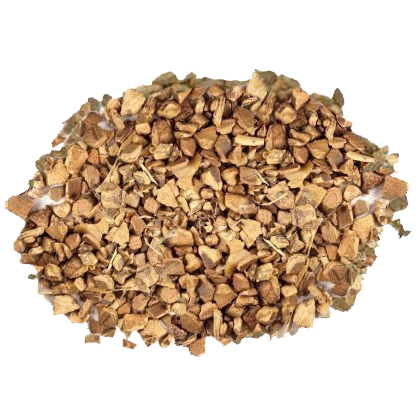
Description: Cut Dried Bark of the Prickly Ash Tree, Zanthoxylum americanum.
✓ Certified Organic
✓ Batch Tested for Purity
✓ Identity Verified Botanical Material
✓ Heavy Metal Tested
✓ Pesticide Residue Tested
✓ Sourced from Trusted Growers
✓ Carefully Dried to Preserve Quality
Traditional use: Historically, many Native American tribes used prickly ash as a medicinal herb. They used an infusion of the bark to treat everything from itchy skin to back pain, for rheumatic conditions, and as a digestive aid.
Today, Prickly ash is commonly used to promote blood flow throughout the body, specifically for the treatment of rheumatism. Rheumatism (including various types of arthritis) is any disease involving pain and swelling or inflammation of the joints, ligaments, and muscles. Prickly ash is said to help improve rheumatism and alleviate joint pain by inhibiting hormones called prostaglandins that stimulate inflammation.
In addition, Prickly ash is said to have numerous other functions and benefits, such as being an appetite tonic, improving digestion and relieving gas, helping bring down high blood pressure and bringing relief in tinnitus, and as an antifungal agent.
Caution: Some people may be allergic to Prickly ash bark. Not recommended to be taken with prescription blood thinners without professional advice. Not recommended for children, or during pregnancy and breast feeding.
Method of Use: Bark Infusion (Decoction).
References:
https://www.verywellhealth.com/the-benefits-of-prickly-ash-4684452
Zhang M, Wang J, Zhu L, et al. Zanthoxylum bungeanum maxim. (Rutaceae): a systematic review of Its traditional uses, botany, phytochemistry, pharmacology, pharmacokinetics, and toxicology. Int J Mol Sci. 2017 Oct;18(10):2172. doi:10.3390/ijms18102172
Ju Y, Still CC, Sacalis JN, Li J, Ho CT. Cytotoxic coumarins and lignans from extracts of the northern prickly ash (Zanthoxylum americanum). Phytother Res. 2001 Aug;15(5):441-3. doi:10.1002/ptr.686
Setzer WN. The phytochemistry of Cherokee aromatic medicinal plants. Medicines. 2018;5(4):121. doi:10.3390/medicines5040121
Millspaugh CF. American Medicinal Plants: An Illustrated and Descriptive Guide to Plants Indigenous to and Naturali. Dover Publication; January 31, 2012
Choudhary M, Kumar V, Malhotra H, Singh S. Medicinal plants with potential anti-arthritic activity. J Intercult Ethnopharmacol. 2015 Apr-Jun;4(2):147-79. doi:10.5455/jice.20150313021918
Bhatta V, Sharmaa S, Kumara N, Sharmaa U, Singha B. Chemical composition of essential oil among seven populations of Zanthoxylum armatum from Himachal Pradesh: chemotypic and seasonal variation. Nat Prod Commun. 2017;12(10):1643-6.